Open Source Projects
Seven open-source repositories plus two coursework projects, ordered by what you can try right now, engineering completeness and problem difficulty. Every entry links to something you can open.
CodeMath
- Problem
- Computer-science maths reads as formulas; readers can follow a proof but never build intuition.
- What I built
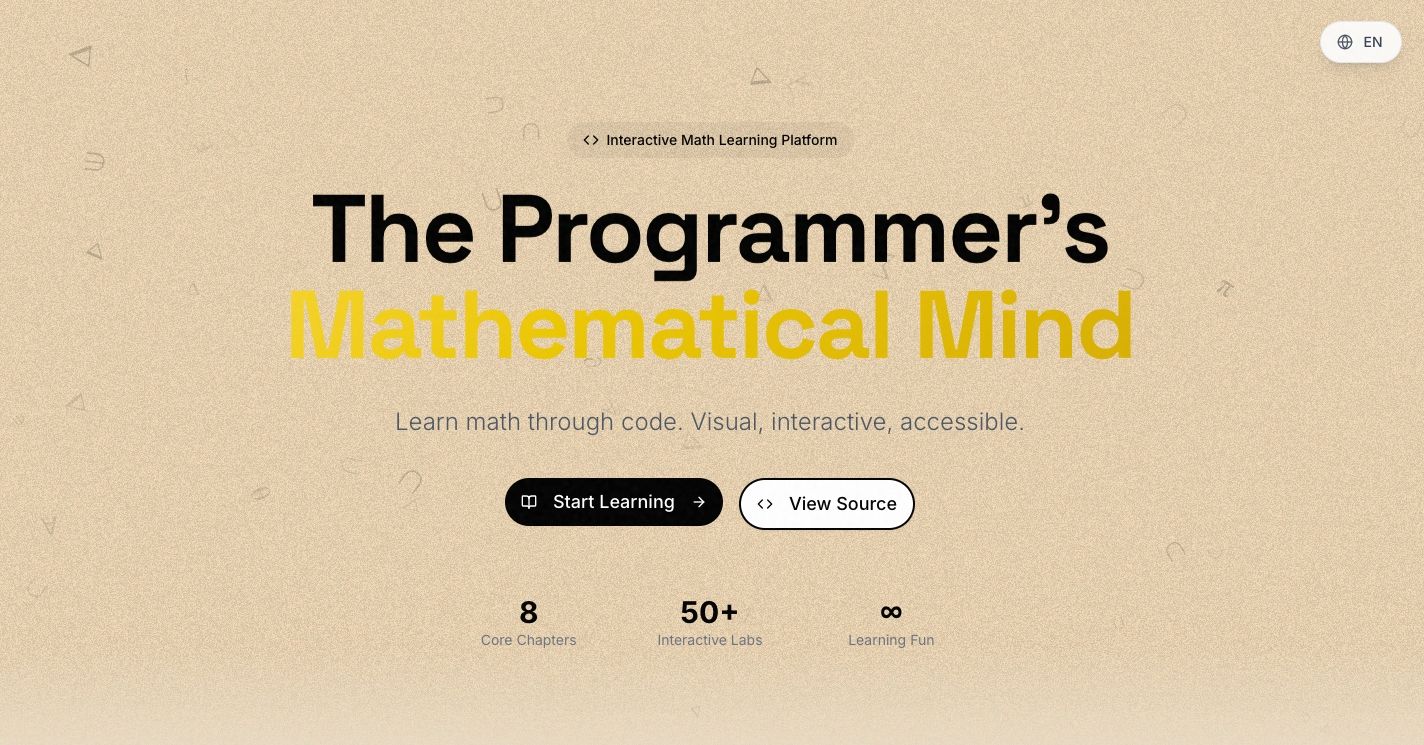
- Nine chapters rebuilt as hands-on demos: base converter, logic-gate bench, truth-table generator, induction dominoes, Tower of Hanoi, fractals, halting-problem simulator. Bilingual UI, one-click start.
- Hardest part
- Turning invisible ideas — the halting problem, inductive proof — into something a reader can manipulate, instead of animating textbook figures.
- Result
- MIT licensed, all nine chapters playable online at codemath.pages.dev
SceneLine
- Problem
- Dubbing practice needs immediate feedback; half a second of silence breaks the flow and the learner loses the thread.
- What I built
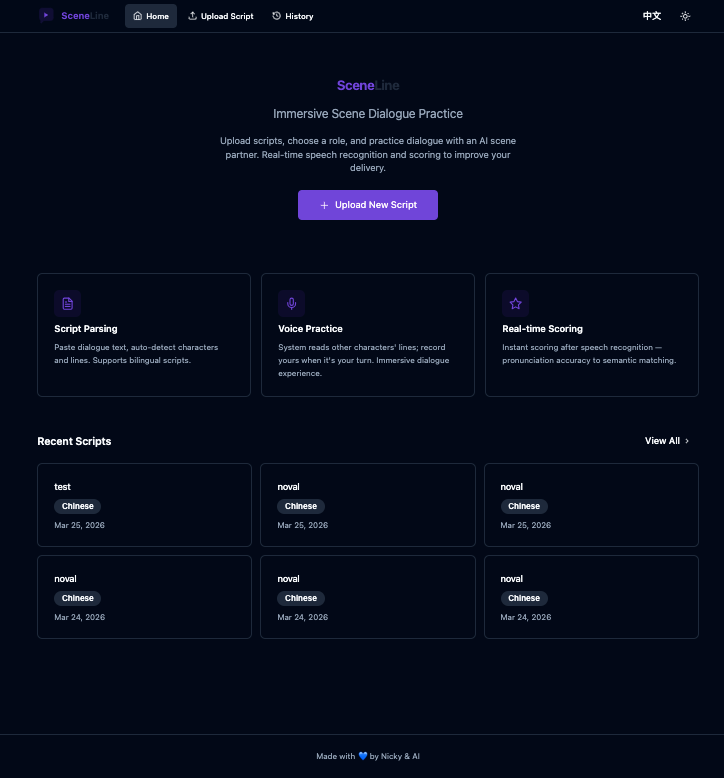
- FunASR as a resident process for real-time recognition, 40+ Edge voices filtered by gender and locale, per-role scoring, three history views, Docker deployment with persistence.
- Hardest part
- Latency first: the resident process buys speed but costs memory and deployment weight. The phoneme-level scorer I tried was less accurate than plain ASR, and is being replaced.
- Result
- MIT, one-command Docker Compose, full deployment scripts in the repo
Scripts to Audiobook
- Problem
- One script has to become audio for several characters: voices must differ, four TTS providers have different quotas and formats.
- What I built
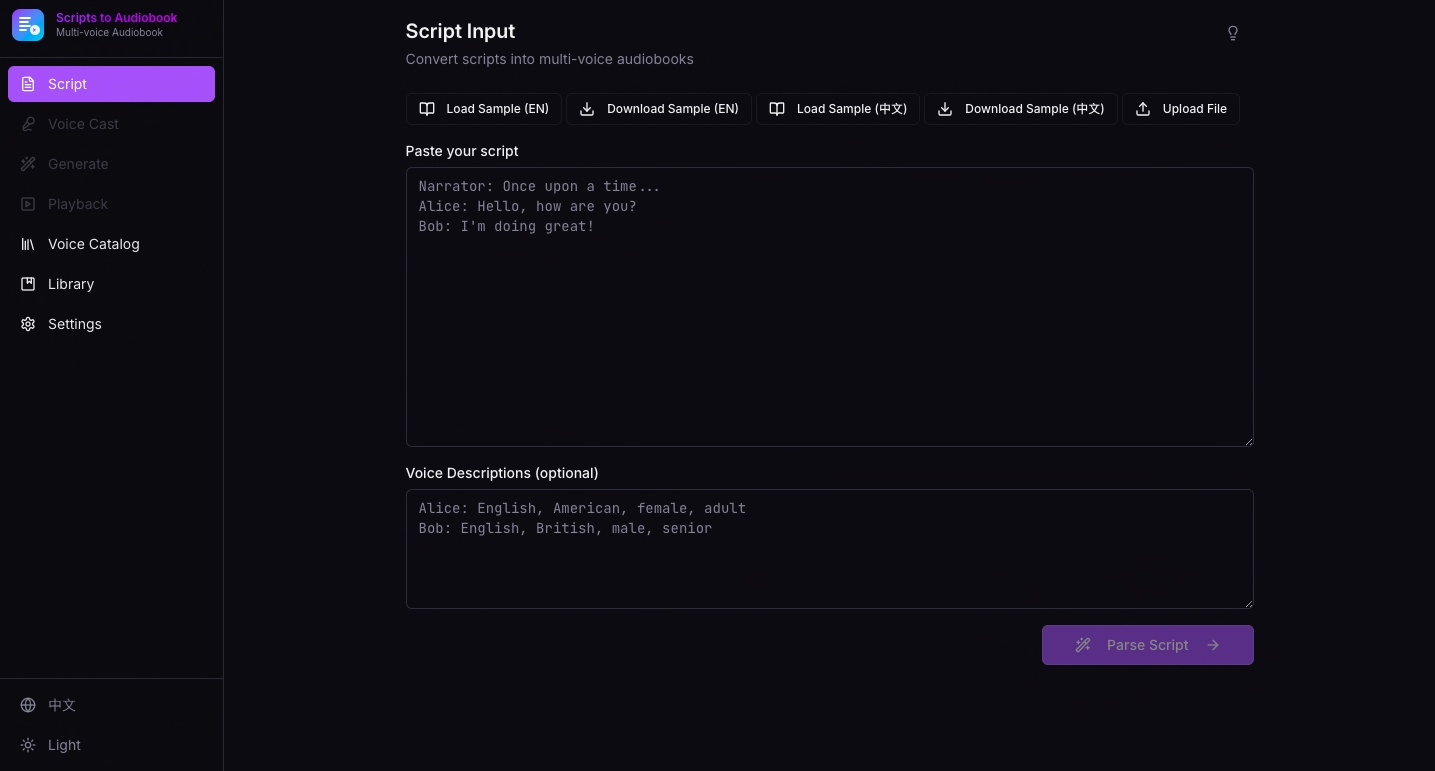
- Four providers behind one interface, weighted voice matching (language, accent, gender, age, narrator fit, diversity penalty) with score explanations, a 61-voice catalog, MP3 + SRT + timeline output, SQLite library.
- Hardest part
- Not making users memorise VoiceIDs: a six-character scene would mean six IDs, so filtering by gender and locale replaced it, with the matcher guaranteeing distinct voices.
- Result
- Runs on free tiers across all four providers; output is a playable MP3 plus SRT
Podcast Studio
- Problem
- A model writing a podcast from scratch invents facts; the path from topic to finished episode is long.
- What I built
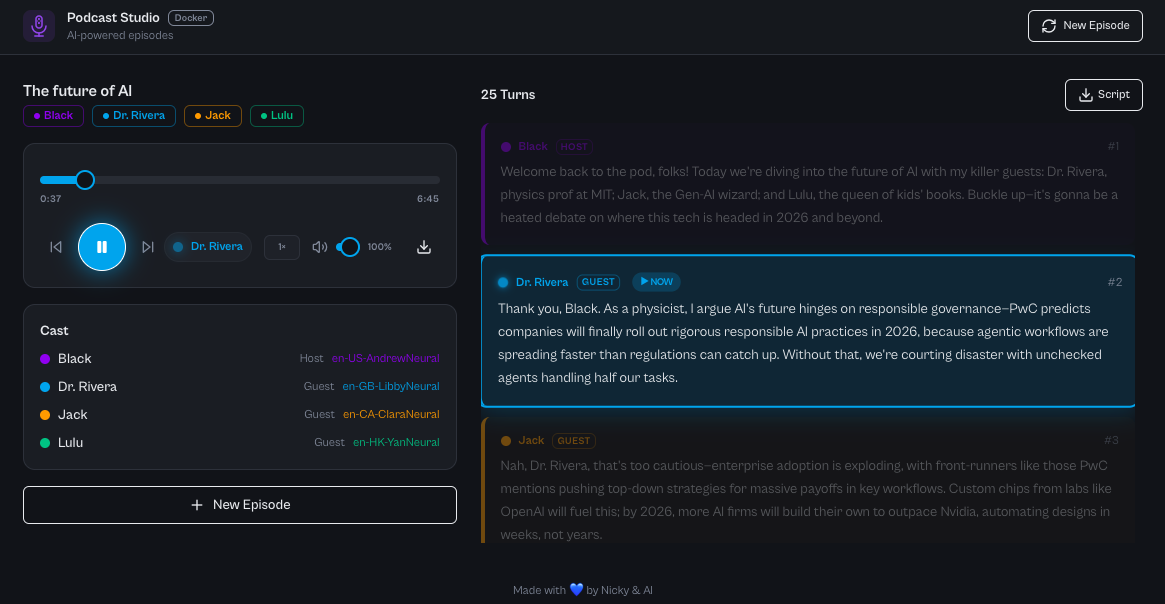
- Perplexity searches recent news first, a multi-turn script is written from those results, each turn gets its own Edge voice, and ffmpeg merges a single MP3. Docker Compose starts everything.
- Hardest part
- Grounding the script in real reporting rather than model recall, while keeping the episode under a couple of minutes.
- Result
- About two minutes per episode; reproducible with Docker Compose

Book to Audiobook
- Problem
- A whole book exhausts free TTS quota, and PDF has no reliable structure to split on.
- What I built
- EPUB/MOBI/AZW3/PDF/TXT in, chapter-marked M4B or MP3 out; chapters can be listed, viewed, edited; local TTS by default (Kokoro on Intel, Qwen3 MLX on Apple Silicon); installable from PyPI.
- Hardest part
- PDF is layout, not structure: extraction is noisy, so manual editing is allowed — while making sure the original text is never overwritten.
- Result
- Six releases; pip-installable; both single-chapter MP3 and whole-book M4B

MovieFairy
- Problem
- Recommenders either feel random or keep narrowing; a two-hour commitment deserves a reason.
- What I built
- Three of eighteen questions produce a mood profile, mapped to nine strategies from mood-management theory, then weighted sampling; blind box, swap, platform filter; PWA offline.
- Hardest part
- Making a recommendation both explainable and non-repeating: softmax sampling keeps high scores likely without being deterministic.
- Result
- Fully static, zero API calls, playable at moviefairy.pages.dev

Edge Read Chrome (ReadAloud)
- Problem
- Built-in browser voices are few and phrased badly; reading sites like WeRead draw text on canvas, so the DOM has nothing.
- What I built
- edge-tts over native messaging, word-level highlighting on a 60 ms timer, site adapters for WeRead (fillText interception), ChineseAll (Swiper + PDF.js), QQ Reading, Tianya, Douban; 0.5×–2.0× speed.
- Hardest part
- MV3 service workers cannot play media, so audio runs in an offscreen document; canvas pages have to be intercepted at fillText to recover coordinates.
- Result
- Five releases; one script registers the native host
Coursework
Two course projects kept for context. Their repositories are not publicly available, so only the companion agents are linked.
Building Generative AI Applications with Gradio
- Problem
- Course exercises scatter across notebooks and get lost after the course ends.
- What I built
- Course code organised into reproducible notebooks, plus a companion Qingyan agent for questions along the way.
- Hardest part
- Keeping every example runnable as dependencies drift.
- Result
- Notebooks and the companion agent are both public

AI Python for Beginners with GLM-4
- Problem
- A beginner course needs answers at the moment of confusion, not in a forum three days later.
- What I built
- Exercises organised alongside the course, with a GLM-4 agent answering in context.
- Hardest part
- Keeping answers tied to the current lesson instead of drifting into general chat.
- Result
- Companion agent usable online